OriEx Apple Export B2B Marketplace and Market Intelligence Platform
A marketplace that connects foreign buyers to real cold storages in West Azerbaijan: structured inventory, one transparent price with no hidden margin, and a market chart that stays unpublished until there is data behind it.
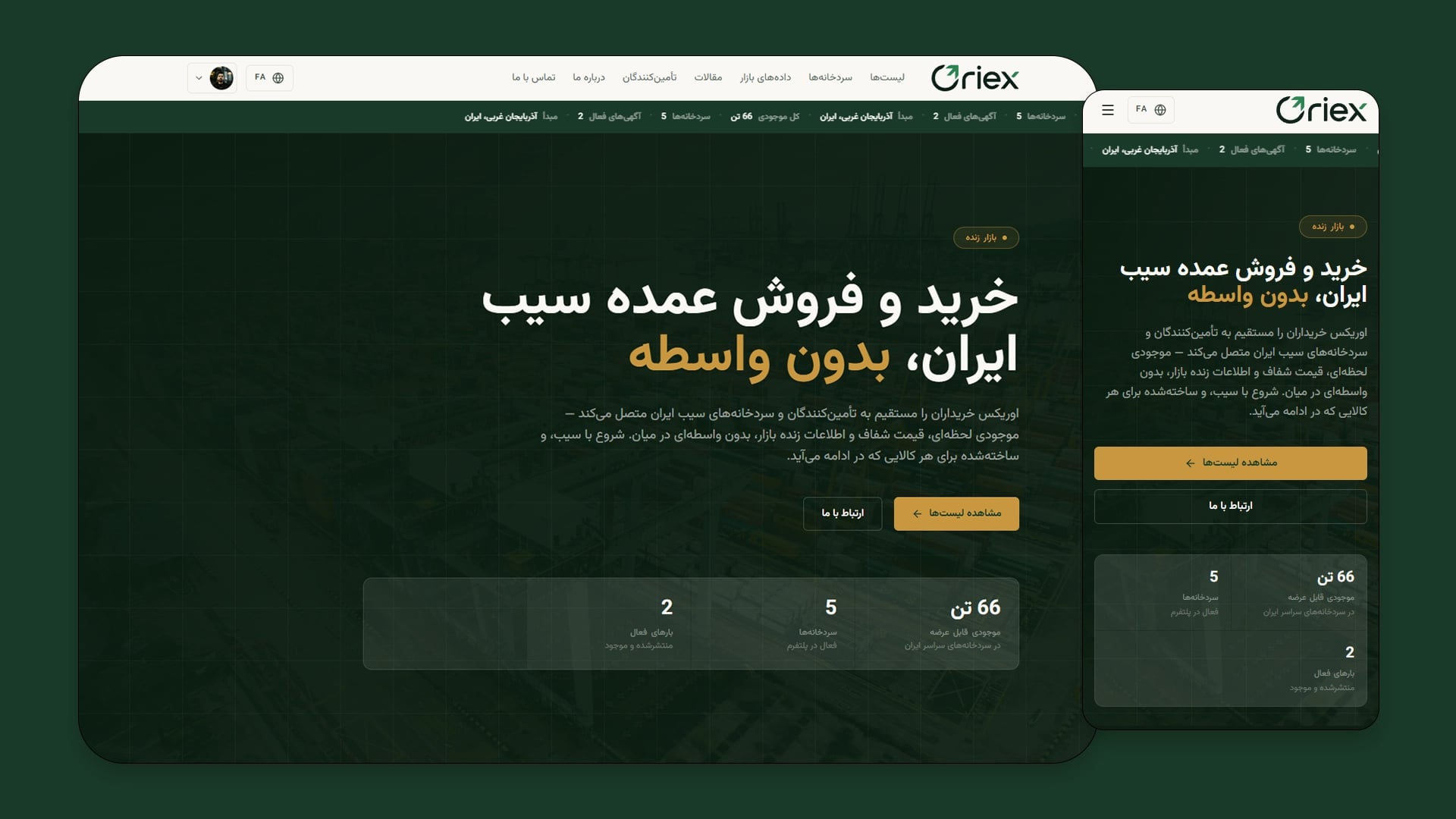
About Project
A B2B apple export platform with structured cold-storage listings, a Toman price and its daily USD equivalent, a market price chart, on-platform chat, subscriptions and a trilingual admin panel.
OriEx is an apple export platform connecting foreign buyers — in Iraq, Russia, the UAE and Central Asia — with growers and cold-storage operators in West Azerbaijan, Iran. The Iranian side already had the fruit and the storage. What it lacked was somewhere to show its inventory and its price, in the buyer's language, kept current.
The problem
Export apple trading still runs on WhatsApp and phone calls. A buyer in Iraq has no way of knowing which variety, at which grade, is sitting in which city this week; the storage operator has no way of knowing who wants it or where they are. The result is a market whose price is set by whoever sits in the middle, rather than by supply and demand.
Language and currency are the second problem. A foreign buyer thinks in dollars and an Iranian seller quotes in Toman. Every manual conversion between the two is either out of date or carries a margin neither side can see.
The season is the third. Apple is a harvest crop: cold storage fills in autumn, sells through winter and empties in spring. For roughly a third of the year there may be no active listings at all — and a site that answers "0 tonnes available" during that stretch makes a working market look dead.
What we built
Every listing became a structured record: variety, quality grade, size, tonnage, packaging, harvest date and the cold storage holding it. All three taxonomies — variety, grade and packaging — are editable from the admin panel, so adding a new cultivar to the catalogue is one row in a table rather than a new release of the software.
A supplier enters one price, in Toman. Its USD equivalent is recomputed every night from that day's exchange rate and published next to it; the rate itself is validated before it is stored, so a source that quotes Rial instead of Toman cannot multiply the whole market by ten overnight. There is exactly one price on the platform: no hidden percentage, no second admin-set figure for foreign buyers.
Supplier phone numbers sit behind sign-in — as a boundary, not a wall. The supplier's name, city, photo, rating and reviews are visible to everyone; only the direct line needs an account. Beside it is on-platform chat, open to any signed-in user, because a conversation the platform can see is better for everyone than a call it cannot. Calls are also limited to 08:00-20:00 Tehran time: the supply side here is growers and storage operators, not a call centre.
The market chart is built from the published listings themselves. Every night a snapshot records the low, high and average for each variety and grade. But no chart is published for a variety until it has accumulated several consecutive days with enough listings behind it — a trend line drawn through three offers is not a market price, it is one seller's asking price. The gap between two seasons is drawn as a dashed segment carrying the date of the last real observation, not as an unbroken line.
Key capabilities
- Structured listings with variety, grade, tonnage, packaging and storage
- One transparent Toman price with a daily USD equivalent
- A market chart that carries its sample size at every point
- A cold storage map filtered by province and city
- On-platform chat between buyer and supplier
- Supplier, buyer and admin dashboards, all three in three languages
The outcome
A buyer now knows three things before placing a single call that they could not know before: which variety at which grade is available in which city, what it costs in their own currency, and where that price sits against the market. Listings are published as structured data (schema.org/Product), so price and availability render correctly in search results too.
On the supply side, an operator can see for the first time how many people viewed a lot and how many tried to reach them about it — a number that simply cannot be counted on WhatsApp.
What was delivered
The platform ships in Persian, Arabic and English, right-to-left for the first two. Iran's 31 provinces and 1,450 cities went into the database so that a storage address and a user's city are selected rather than typed. A typed city has no translation and reads identically in all three languages, and that small detail is the difference between a multilingual platform and a translated website.
Three dashboards were delivered: a supplier dashboard for listings, chat and performance analytics; a buyer dashboard for purchase requests and saved listings; and a 68-page admin panel covering listings, storages, users, subscriptions, payments, SEO, articles, support tickets and behavioural analytics. One account can hold both sides at once and switch between the two dashboards from the sidebar.
Revenue comes from subscriptions, never from a cut of a deal. Registering, publishing listings, being found on Google and chatting are free and permanent; the Pro plan sells more of the demand the platform sees, plus performance analytics. Payments run through an online gateway, and a scheduled job reconciles unverified payments every fifteen minutes so a dropped gateway callback never ends as "charged, and no subscription".
The platform installs on a phone and sends browser notifications — for an operator who spends the day inside a cold storage, that notification is the difference between answering today and answering tomorrow. Identity verification checks a national ID card to confirm a person, and the document image is destroyed the moment a decision is made. OriEx makes no claim about fruit quality, storage conditions or financial standing, and none of the copy on the site implies one.
This apple export platform is live and open to visit. Browse the rest of our work on the portfolio page, or start your own project from the contact page.